
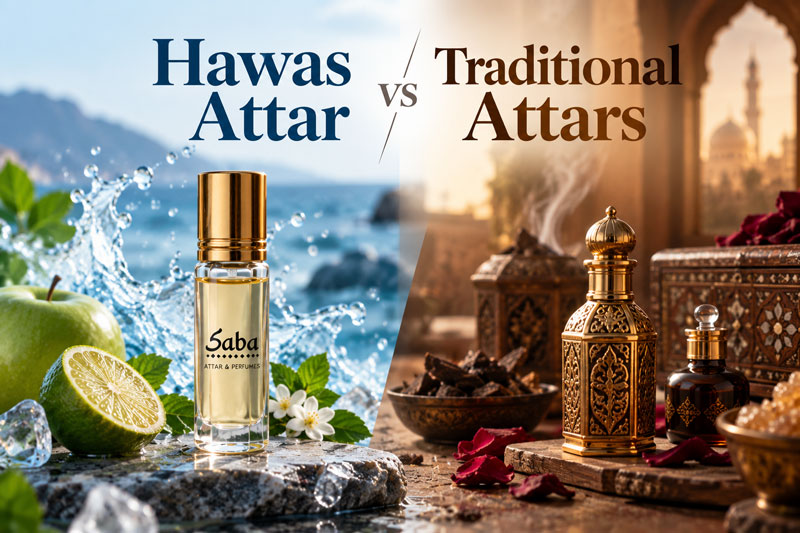
When people hear the word attar, they often imagine classic fragrances such as rose, jasmine, musk, oud, sandalwood, khus or other deep, warm and traditional perfume oils.
But Hawas Attar feels different.
It still comes in the familiar concentrated oil/roll-on format, but its fragrance profile is much closer to the world of modern aquatic and fresh perfumery. Instead of opening with a predominantly traditional floral, woody or warm character, it combines citrus, juicy fruits, aquatic accords, aromatic spices, musk and soft woods to create a fresher and more contemporary experience.
So, what exactly makes Hawas Attar smell so modern?
Let’s compare it with the traditional attar experience.
What Makes Traditional Attars Smell Traditional?
Traditional Indian attars have a strong connection with natural materials, oil-based perfumery and the historic art of distillation.
Traditional deg-bhapka attar making involves heating aromatic materials and capturing their fragrant vapours into a receiving vessel containing a base oil, traditionally sandalwood oil. This method continues to be associated with the traditional perfumery craft of Kannauj.
Depending on the type, traditional attars can have profiles such as:
- Rose and other florals
- Sandalwood
- Oud and woods
- Musk
- Khus/vetiver
- Earthy notes
- Spices
- Warm oriental accords
These fragrances often feel rich, warm, earthy, floral, woody or deeply musky.
That doesn’t mean every traditional attar smells heavy. There are many lighter traditional fragrances too. But the overall fragrance vocabulary is different from what you normally associate with modern aquatic perfumes.
So Where Does Hawas Attar Fit In?
Hawas Attar takes the attar format and gives it a much more contemporary fragrance direction.
Saba describes Hawas Attar as a fresh, aquatic and aromatic fragrance with citrus, fruity and musky characteristics. The detailed fragrance profile moves from fruity-citrus notes into aquatic and aromatic accords before settling into musk, woods and deeper amber-toned elements.
That progression is one of the main reasons it feels modern.
Instead of smelling like a single traditional ingredient from beginning to end, Hawas creates a changing fragrance journey.
Fresh → Fruity → Aquatic → Aromatic → Musky/Woody
And that is very different from what many people expect when they first hear “attar.”
Hawas Attar vs Traditional Attars
| Feature | Hawas Attar | Traditional Attar Style |
|---|---|---|
| Overall character | Fresh, aquatic, fruity | Often floral, woody, earthy or warm |
| Opening | Citrus + juicy fruits | Often dominated by its primary botanical/material |
| Heart | Aquatic + aromatic | Floral, herbal, spicy or woody depending on attar |
| Dry down | Musk + woods + amber-toned depth | Often sandalwood, musk, woods or other traditional bases |
| Fragrance impression | Modern and energetic | Classic and traditional |
| Best suited to | Daily wear, summer, casual, office, active routines | Depends on the attar; often traditional occasions and personal fragrance |
| Application | Roll-on oil | Usually oil/roll-on |
| Alcohol | Alcohol-free | Traditional attars are oil-based |
The important point is that Hawas isn’t trying to replace traditional attars.
It offers a different fragrance experience within the attar format.
1. The Citrus Opening Makes It Feel Instantly Fresh
One of the biggest differences is the opening.
Hawas Attar features crisp green apple, sweet plum, bergamot and lemon in its detailed fragrance profile.
These ingredients create an opening that feels:
- Bright
- Juicy
- Fresh
- Energetic
- Slightly sweet
- Youthful
This is very different from opening with a predominantly rich rose, deep oud or earthy traditional accord.
The result is a fragrance that feels immediately familiar to someone who enjoys modern fresh perfumes.
2. The Aquatic Heart Changes Everything
The word aquatic is probably the biggest clue to why Hawas smells modern.
Traditional attars can certainly contain fresh or cooling characteristics, but aquatic fragrance is strongly associated with contemporary perfumery.
Hawas moves from its fruity-citrus opening into oceanic aquatic accords with aromatic elements, creating the impression of freshness and coolness.
Think of the difference between:
Warm woods + floral richness
and
Fresh air + water + citrus + clean musk
The second profile naturally feels more contemporary.
This is also why Hawas can work particularly well when you don’t want a fragrance that immediately feels heavy or formal.
3. Fruits Give Hawas a Younger Personality
Another interesting characteristic is the use of fruity notes.
Apple and plum add a juicy sweetness to the fragrance, while citrus keeps the opening from becoming overly sweet.
This combination gives Hawas a personality that can be described as:
Fresh + Fruity + Clean + Energetic
That makes it particularly interesting for people who love modern perfumes but prefer the convenience of an attar.
4. Aromatic Spices Add Depth
Hawas isn’t simply a fresh aquatic fragrance.
Its heart includes cinnamon, orange blossom and cardamom, according to Saba’s fragrance breakdown.
These aromatic elements add warmth and complexity underneath the freshness.
This is important because an entirely fresh fragrance can sometimes feel very straightforward.
The aromatic heart gives Hawas more dimension:
Citrus → Fruits → Aquatic freshness → Aromatic warmth
That transition helps prevent the fragrance from smelling flat.
5. The Dry Down Brings It Back to the World of Attar
Here’s where things become particularly interesting.
Although Hawas opens with a modern aquatic character, its dry down becomes more familiar to someone who enjoys concentrated perfume oils.
Saba’s listed base includes ambergris, driftwood, earthy patchouli and clean white musk.
So after the bright opening and aquatic heart, the fragrance gradually becomes:
- Musky
- Woody
- Smooth
- Deeper
- More grounded
In other words, Hawas starts modern and fresh but doesn’t remain simply “watery.”
The musk and woody elements give it the lasting depth expected from a concentrated fragrance oil.
Why Does Hawas Attar Feel Different From a Typical Attar?
The easiest way to understand it is this:
Traditional attar often starts with the material. Hawas starts with the fragrance experience.
A traditional rose attar, for example, is built around the character of rose.
A traditional sandalwood attar revolves around sandalwood.
A traditional khus fragrance highlights its earthy, green and cooling character.
Hawas, on the other hand, combines multiple fragrance ideas:
Citrus + Fruit + Aquatic + Aromatic + Musk + Woods
That multi-layered structure is what gives it a more contemporary perfume-like personality while retaining the convenience of an oil-based attar.
Is Hawas Attar Good for Indian Summers?
This is where the profile becomes particularly practical.
Hot and humid weather can make very dense fragrances feel overwhelming. Fresh citrus and aquatic profiles are often preferred when people want a cleaner and more refreshing fragrance impression.
Saba specifically positions Hawas Attar for hot weather, daily outings and active routines, including summer conditions in India.
That makes it an interesting option for:
- Summer outings
- Casual wear
- Office
- College
- Gym and active routines
- Daytime events
- Travel
- Everyday fragrance
Of course, fragrance performance varies from person to person depending on skin, climate, application and environment.
Hawas Attar for People Who Love Modern Perfumes
This is perhaps the most interesting reason to try Hawas.
Some people like the idea of attar, but their fragrance preference is modern.
They may enjoy:
- Fresh aquatic perfumes
- Fruity fragrances
- Clean musk
- Citrus scents
- Contemporary masculine fragrances
- Fresh everyday perfumes
But traditional rose, oud, sandalwood or heavily oriental attars may not be their first choice.
For such fragrance preferences, Hawas provides a bridge between the two worlds.
You get the oil-based attar format, but the scent direction feels much closer to modern perfumery.
Can Men and Women Wear Hawas Attar?
Yes.
Saba lists Hawas Attar as suitable for both men and women, with its combination of fruitiness, aquatic freshness and musk giving it a broadly wearable profile.
However, fragrance is highly personal.
Someone who loves deep oud may find Hawas too fresh, while someone who normally wears citrus and aquatic perfumes may find it exactly what they are looking for.
That’s why choosing fragrance based on scent preference can be more useful than choosing only by gender.
How to Apply Hawas Attar
Because Hawas is an oil-based roll-on fragrance, you don’t need to apply a large quantity.
Try:
- Apply a small amount to your wrists.
- Dab behind your ears.
- Apply lightly around the neck/pulse points.
- Allow the fragrance to develop naturally rather than rubbing it aggressively.
- For clothing, use a very small amount and test the fabric first.
Saba recommends pulse-point application and keeping the bottle away from direct sunlight and extreme heat.
The goal with attar isn’t to soak yourself in fragrance.
A little can be enough.
Hawas Attar vs Oud Attar: Which One Feels More Modern?
If you’re deciding between a fresh Hawas-style fragrance and an oud-based attar, the difference is quite straightforward.
Choose a fresh aquatic profile if you enjoy:
- Citrus
- Fruits
- Freshness
- Aquatic notes
- Clean musk
- Modern perfume styles
Choose an oud-focused profile if you enjoy:
- Deep woods
- Richness
- Warmth
- Smoky or resinous characteristics
- Stronger traditional/oriental fragrance styles
Neither style is inherently better.
They simply create very different fragrance experiences.
Is Hawas Attar Good for Daily Wear?
For someone who prefers fresh and modern fragrances, yes, it can be a practical everyday option.
Its combination of citrus, fruits, aquatic accords, aromatic notes and musk gives it enough freshness for daytime use while the woody and musky base provides additional depth.
It can work particularly well when you want one fragrance that isn’t restricted to formal occasions.
Office in the morning?
Hawas can work.
Casual outing?
Hawas can work.
Summer day?
The aquatic-citrus character fits the occasion.
Evening casual wear?
The musky and woody dry down gives it enough depth to continue into the evening.
Who Should Try Hawas Attar?
Hawas Attar may be worth exploring if you:
- Prefer fresh fragrances over heavy ones
- Love aquatic perfume profiles
- Enjoy fruity-citrus openings
- Want an attar with a modern personality
- Prefer concentrated oil fragrances
- Want something suitable for everyday wear
- Like clean musk and soft woody dry downs
- Want a fragrance that works across different occasions
- Are new to attars but already enjoy modern perfumes
On the other hand, if your favourite fragrances are extremely traditional, earthy, heavily floral or very deep oud-based scents, Hawas may feel noticeably different.
And that’s exactly what makes it interesting.
The Real Difference: Tradition in Format, Modernity in Fragrance
The most interesting thing about Hawas Attar isn’t that it is “better” than traditional attars.
It’s that it shows how attar as a fragrance format can evolve with changing fragrance preferences.
Traditional attars have a rich history and distinctive fragrance identity. Modern fragrance oils can take that same convenient, concentrated format and explore completely different scent directions.
Hawas sits somewhere in between.
The format feels familiar.
The fragrance feels modern.
With citrus and juicy fruits at the opening, aquatic and aromatic notes in the heart, and musk and woody elements in the dry down, Hawas creates a fragrance journey that feels much closer to contemporary perfumery than many people expect from an attar.
That’s what makes it an interesting choice for someone who says:
“I like attar, but I want something fresh and modern.”
If that’s your fragrance preference, Hawas Attar is exactly the kind of profile worth exploring.
Frequently Asked Questions
Is Hawas Attar a traditional attar?
Hawas is an alcohol-free concentrated perfume oil/attar, but its fragrance profile is inspired by modern aquatic perfumery rather than being a classical floral or traditional botanical attar style.
What does Hawas Attar smell like?
It has a fresh, fruity and aquatic character with citrus and fruit in the opening, aquatic and aromatic notes in the heart, and musk, woods and deeper amber-toned elements in the base.
Is Hawas Attar good for summer?
Its citrus and aquatic character makes it particularly suitable for people who prefer fresh fragrances in warm weather. Saba specifically positions it for hot Indian summers and everyday outings.
Can women wear Hawas Attar?
Yes. Saba describes Hawas Attar as suitable for both men and women.
Is Hawas Attar suitable for daily wear?
Its fresh, aquatic, fruity and musky profile makes it suitable for everyday settings such as casual outings, office wear and active routines.
Is Hawas Attar alcohol-free?
Yes. Saba lists Hawas Attar as a non-alcoholic perfume oil.
Try Hawas Attar by Saba
If you want to explore an attar that moves away from the stereotypical heavy, traditional fragrance profile and towards fresh aquatic, fruity and modern perfumery, Hawas Attar is an interesting option.
It gives you the convenience of a concentrated roll-on while offering a fragrance profile built around citrus, fruits, aquatic freshness, aromatic notes, musk and woods.
Explore Hawas Attar by Saba Attar & Perfumes and discover a more modern side of attar. Hawas Attar by Saba Attar & Perfumes